
Ask any firm which process they would automate first and the answer comes quickly. It is usually the one that generates the most complaining.
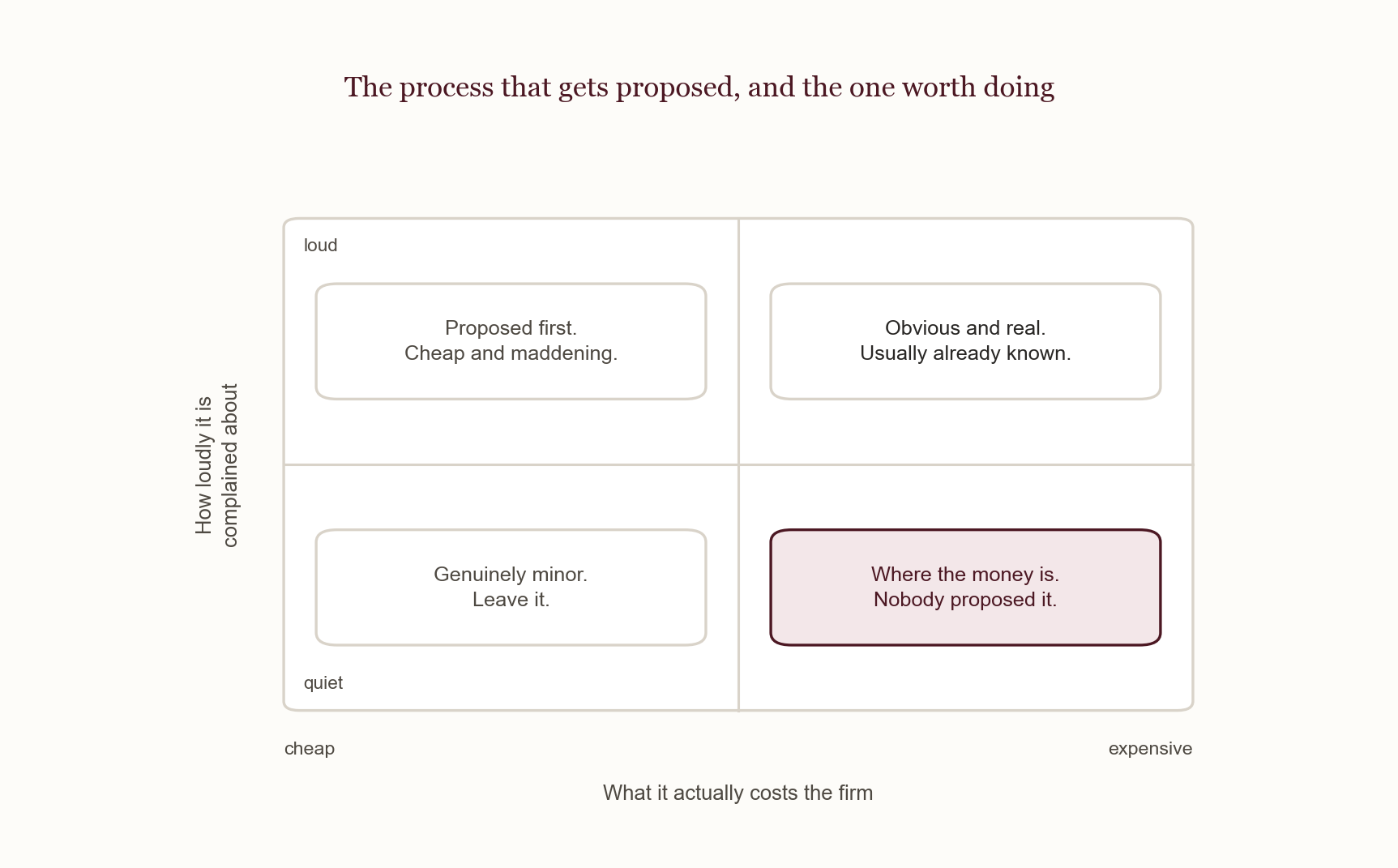
The most irritating process and the most expensive process are rarely the same one. The irritating one is what gets proposed, because irritation is loud and cost is quiet.
Why irritation is a poor guide
Irritation tracks how a task feels rather than what it consumes. A task can be maddening and cheap: fiddly, interruptive, badly designed, and finished in four minutes a day. Another can be enormous and calm, spread across many people in small amounts, none of whom would name it if asked what wastes their time.
Three distortions push firms towards the wrong one.
The loudest complaint comes from whoever is most senior. A partner doing something clumsy for ten minutes a week is more audible than six administrators doing something clumsy for an hour a day. The senior person's ten minutes is also genuinely more expensive per minute, which makes the argument feel sound.
Recent pain outweighs constant pain. A process that failed badly last month is vivid. A process that has been mildly wasteful for four years is invisible, because it has become the way things are.
Visible steps get counted and waiting does not. Firms measure the work and rarely measure the gaps between it. An item that takes twenty minutes of effort and sits for nine days is recorded as a twenty minute task.
What actually makes a process expensive
Four things, and they can be estimated in an afternoon without a study.
Volume times frequency. How many times a year does this happen? A task done twice a year is not a first project regardless of how bad it is.
Total human minutes, across everyone who touches it. Including the people who are not in the room. Administrators, the person who chases, the reviewer who sends it back, whoever re-does it.
What it blocks. Some processes are only expensive because nothing downstream can start until they finish. The task itself may be small and the wait it creates may be the whole schedule. This is where a firm usually finds its largest number, and it is the one least likely to be in anybody's estimate.
Rework rate. How often is it done twice? Rework is usually recorded as the same task happening again rather than as a defect, so it hides in the volume.
Multiply the first two and you get direct cost. Look at the third and fourth and you often find it is several times larger.
A way to sort the candidates
Take the list of proposed processes. For each one, answer four questions with a number, an estimate, or a shrug. The shrugs are informative.
- How many times a year?
- How many total minutes per occurrence, counting everyone?
- When it is slow, what waits?
- How often does it have to be redone?
Then ask a fifth question, which is about feasibility rather than value.
- Is the process the same every time, and can you describe the rule?
A process that varies with judgement on every instance is a poor first project, however expensive. A process where an experienced person could write down what to do in a page is a good one, because that page is most of the specification.
The first project wants to score well on question five and reasonably on the others. Saving the largest number is the wrong target for a first attempt, because the largest number usually sits inside the most judgement-heavy process in the firm.
What a good first project looks like
It is bounded. One process, one department, a clear start and a clear finish.
It is measurable before you begin. Somebody wrote down how long it currently takes and how often it goes wrong. Without that number, the result can only be assessed on whether it feels better, and it will, because it is new.
It fails safely. If the system is wrong, a person catches it in the normal course of the work rather than a client catching it later.
It is something a person still checks. The first project is where a firm learns whether it trusts this kind of work, and that judgement needs evidence.
The question that sorts it in one meeting
Put the candidate processes on a whiteboard. For each one ask: if this took one hour instead of one week, what would change for the firm?
Some answers are "nothing much, it would just be less annoying". That is a real benefit and it is not a first project.
Some answers are "we could start the work eight days earlier" or "we would stop losing the February ones". Those are the processes where the cost was in the waiting, and they are usually the ones nobody proposed.
The process worth doing first is generally the one that somebody describes, halfway through the meeting, with the phrase "well, that is just how it works here".