
Every firm has a way of knowing what it has asked clients for and what has come back. A portal, a checklist, a spreadsheet, a request list inside the engagement software. Items go out, items come back, the list turns green.
The list going green is a statement about arrival. Whether the work can now proceed is a separate question, and in most firms it is answered by a person opening the file and looking.
The gap between the two states
A document can arrive and still not close the item. The common ways:
Wrong period. The request was for the year ended December. What arrived covers eleven months, or thirteen, or the calendar year for a business with a June year end.
Partial. Pages two through six of a nine page statement. The first and last pages are often the ones that carry the totals.
A photograph. A phone picture of a screen showing a statement, taken at an angle, with the top line cut off. It is legible to a human who squints. It is not data.
The wrong export. A summary where a detail was needed. A printed PDF of a report where the underlying file would have taken the same click.
Right document, wrong entity. The related company, the personal account, the old EIN.
Password protected, with the password in a separate email that went to somebody else.
None of these are exotic. Any experienced person can list them from memory. The point is that every one of them produces the same signal in the tracking system, which is that something arrived.
Why the cost is larger than it looks
The obvious cost is the second request. Somebody notices, writes to the client, waits again.
The larger cost is when the noticing happens. If the file is opened the day it arrives, the second request goes out immediately and the client is still thinking about the subject. If it is opened when the work actually starts, the discovery might be two weeks later. The client has moved on, the request now feels like a new imposition, and the schedule that was built on a green list was built on a fiction.
There is a third cost that rarely gets counted. A list that reports arrival rather than usability gradually stops being trusted. People learn to check it and then check the files anyway. At that point the firm is maintaining a tracking system and doing the tracking by hand.
What checking on arrival actually involves
Most of these failures are detectable the moment the file lands, by something other than a person.
Whether a document covers the period requested is readable from the document. Whether a statement is complete is often a matter of page numbering and whether the closing balance is present. Whether a file is a photograph rather than an export is a property of the file itself. Whether it is machine readable at all is the first thing any processing step discovers. Whether the entity name matches the one on the engagement is a comparison.
None of that is difficult. It is simply work that nobody has time to do on every file, which is precisely the kind of work worth handing to a system.
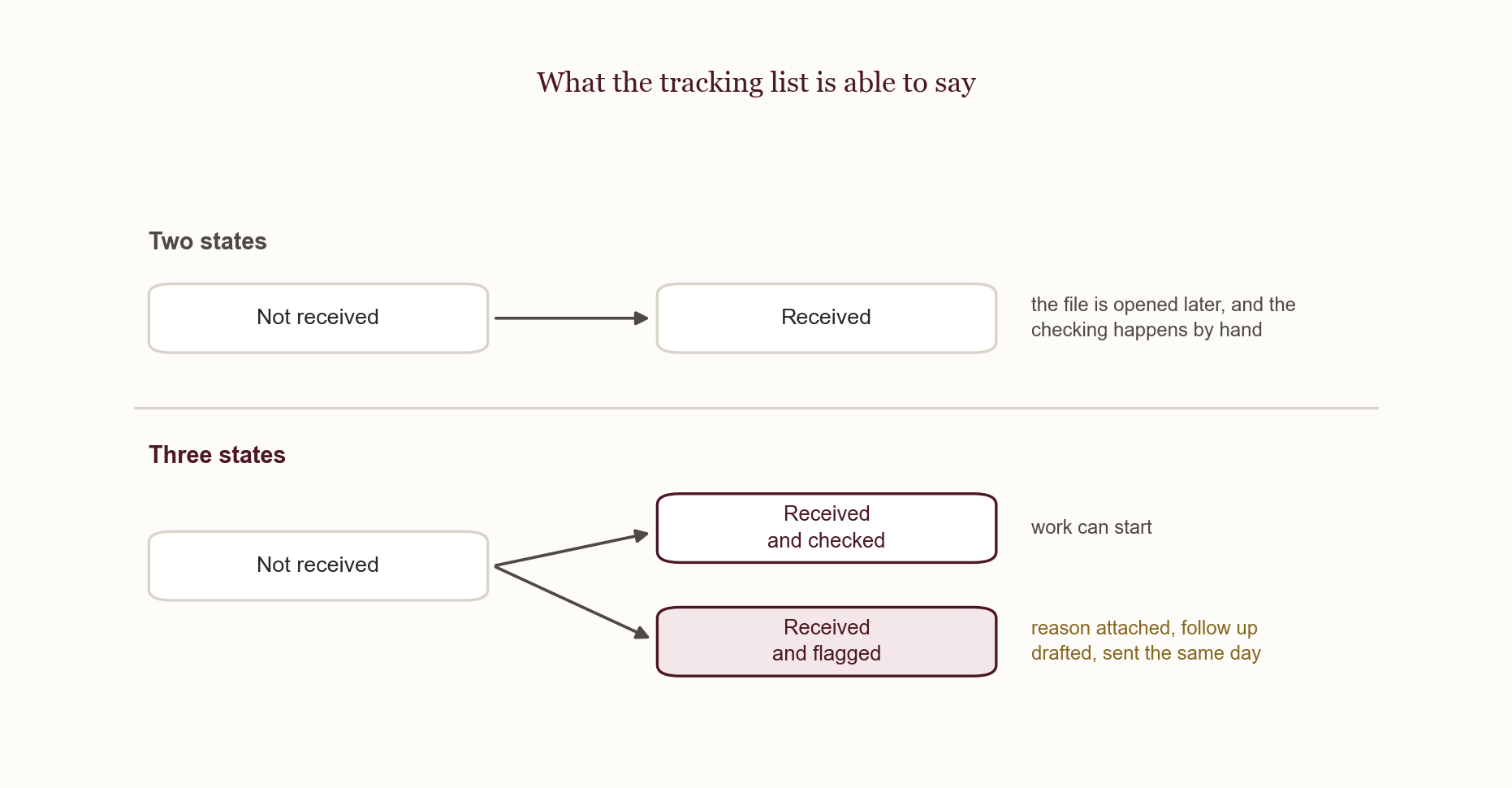
The output is a change to what the tracking list means. Instead of two states, there are three. Not received. Received and checked. Received and flagged, with the reason attached and the draft of the follow up already written.
That third state is the one that changes the week. The follow up goes out the same day, with a specific reason, to a client who still remembers sending the thing.
Where judgement stays with people
It is worth being clear about the limits, because the failures that a system catches are the mechanical ones.
A document can be the right period, complete, machine readable, correctly named, and still be wrong in a way that only a person will see. The numbers may not reconcile to anything. The classification may reflect a treatment the firm disagreed with last year. The client may have sent exactly what was asked for when what was asked for was the wrong thing.
A checking step does not replace the review. It removes the portion of the review that is mechanical, so that the person opening the file is looking at something that has already cleared the obvious hurdles.
The question to ask about your own list
Pick the last engagement that ran late. Look at when each document arrived and when it was first opened by somebody who could tell whether it was usable.
If those two dates are the same for most items, the checking is already happening on arrival and it is being done by people. That is a cost, and it is a visible one.
If there is a gap, the gap is where the schedule quietly went. Every item in it was green on the list and none of it was ready, and nobody could have known without opening the files.
Either answer is useful. The second one is the more common, and it is the one worth measuring before deciding whether anything needs to change.